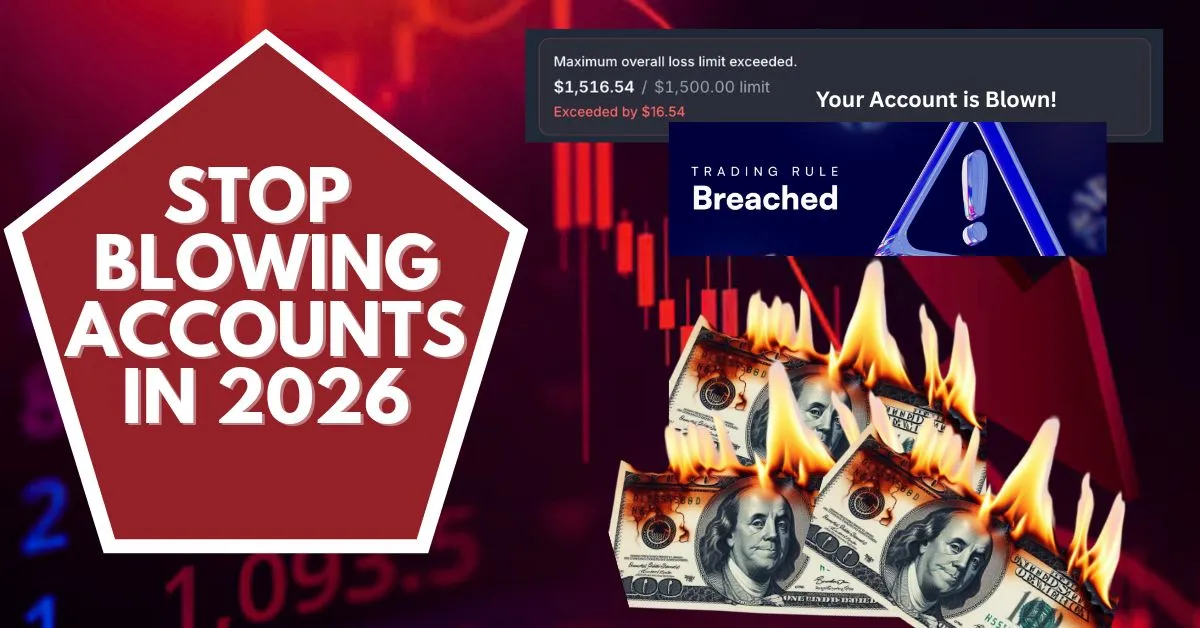
Wait a Minute, if you are searching on google How to Stop Blowing Trading Accounts..Stop right there and listen to me carefully. Most trading blogs will tell you that blowing an account is “part of the journey.” They’ll tell you to take a Day off, a week off, meditate, and come back when you’re “centred.” That is garbage advice.
Let me give you a guide about this mindset. You aren’t blowing Trading accounts just because your strategy is weak or your technical analysis is wrong, if that was the case you might have searched for how to trade or trading strategy for beginners but no here you are because you tried your best to keep you trading accounts alive and make money from it, I understand, my friend. Because I was at the same position where you are right now.
Look, taking a break doesn’t fix a broken psychological system. If you just blew a $10,000 trading account or funded account, it wasn’t because you lacked technicals—it’s because you were a victim of the Market.If you want to stop the cycle of blown accounts, you don’t need more “motivation.” You need a mechanical tourniquet. In this guide, I’m breaking down the raw math of survival and my 3-step Secret Model I use to keep my emotions locked out and my funded or trading account alive.
[Note: Some of you may trade a Funded Account instead of a broker account, so I may call the trading account a Funded account sometimes in this article and don’t get confused, they are both the same.]
The “Take a Break” Myth: Why Conventional Trading Psychology Fails
After you blow an account, you might have seen that the YouTube trading gurus always give the same advice: take a walk, clear your head, and come back fresh. This could not be more wrong, and I’m speaking from painful, brutal experience. I used to do that. I had hit my max drawdown, closed my laptop in dramatic way, and promise myself I wouldn’t look at any charts for rest of the week. I would go out and distract myself “to reset the mentality.” But here’s the thing, upon returning and opening a live chart the Monday after, what do you think happened? Yep, you guessed it, nothing.
All of the fear, greed, and revenge trading urges were right there, waiting for me to take my mental control again. If you walk away for a break, it’s not going to help you. If you think relying on willpower and self-control to break the cycle, think again, it will be there, and all the triggers are waiting at the red candles. You can’t walk away from your bad trading and clear your head. Your bad execution can’t be escaped by “resting.” You can’t sit back and meditate your anxiety away. When real money is on the line and the pressure is on.
My advice and the only real answer to this problem is not taking some time away to think, it is learning to alter your behaviour with a strict, systematic set of rules that doesn’t give your emotions the option to make a mistake.. You have to set some ground rules for trading and how is that, read along, you’ll know.
The Psychological Weight of Live Capital: Why Demo Discipline Collapses?
Let’s talk about the biggest lie in the trading industry: “If you are profitable on a demo account, you are ready for a live account.” I used to believe that garbage. I used to trade on my demo accounts, follow my rules perfectly, …make millions of dollars in demo and think “hah, I had the markets completely figured out”. But the second I stepped into a live environment or got my hands on a funded trading account? My discipline completely shattered. In fact, that psychological shift is exactly how most traders fail instant funded accounts in 2026. I became a completely different person with an Ego problem
Why does this happen in trading? Because you do not blow accounts because you suddenly forgot how to read market structure or identify a supply and demand zones. You blow them because the psychological weight of live capital physically hijacks your brain.

The pressure builds, and one small, mathematically normal loss suddenly feels like a personal attack and that changes the mental attitude to view the market. The fear of losing that account makes you hesitate on good setups, and the desperation to make the money back makes you forced to take trades on terrible ones. Your discipline collapses under the weight of your own financial expectations, and you completely abandon your edge. You aren’t managing risk anymore; you are just fighting for survival.
Inside the “Gambler” Meltdown: The Cycle of Blown Accounts
Let’s be completely honest with each other. You don’t blow a whole account on one normal losing trade. You blow it because one bad trade triggers a complete mental meltdown. I call it going into Gambler mode. I remember staring at my screen at 2 AM, watching a small red number turn into a massive hole because I just couldn’t accept the loss mentally, and I started doubling the risk to make it all back. And that is how you also treat your trading accounts, where you abandon your trading plan and start trading your ego after that one bad trade. It is a repeated cycle, and it usually happens in two brutal stages.
The FOMO Trap
I know man, we all been there. You were busy step away to grab a coffee, come back and see a massive green candle breakout out of a important label or zone. You completely missed the move. And your chest tightens, you blame the market that “it was supposed to happen when I was out”. That fear of missing out kicks in hard. Instead of patiently waiting for the next proper setup, you jump in at the very top just because you want a piece of the action.
And then, you know what? The market instantly reverses from the area you bought. Now you’re in a panic, holding a terrible position that you were never supposed to take in the first place. You are no longer trading my friend, you are just hoping price to come to breakeven and guess what it never comes and then comes the Ego. Breakeven or nothing, and you exit with a very big loss.

The Chart Illusion
Then comes the absolute worst part. Desperate to fix the mess, you drop down to the 1-minute chart. You start seeing trading setups that don’t even exist. Every tiny move in the price looks like a massive opportunity, you double up the lot sizes and try to capture small pips to make it back.
You convince yourself, “If I just catch this one little bounce, I’ll make it all back and close my laptop.” But it is a total illusion. It is just random market noise. You end up taking fifteen forced trades in an hour, hits your daily loss limit or hard limit and ultimately get liquidated. I know the pain because I lived it. But to break this cycle, you have to lock the gambler out completely.
Transitioning to the “A-Grade Professional”: The Apex Execution Protocol
Let’s get real. A professionals don’t survive because they have more willpower than you. I used to believe that I simply needed more self-control, but willpower just vanishes when you are staring at a bleeding account. I had to learn to trust rigorous rules instead of my emotions in order to become what I refer to as a “A-Grade Professional.” I created a system that I refer to as the Apex Execution Protocol. Yes this is the solution I was mentioning earlier in this article. Surviving your own mind is more important than figuring out the ideal chart pattern. These three mechanical guidelines are what ultimately prevented me from blowing my accounts.
The Hard 1R Limit (Building Pain Tolerance)
You need to learn how to take a punch. For me, the biggest trap was taking a normal loss and instantly trying to “make it back” in the next five minutes. That’s exactly when the gambler takes the steering wheel. Now, I use a hard 1R (one unit of risk) limit. If I risk that 1% and hits Stoploss, I take the hit without flinching. You have to mentally accept that small loss as a business expense. No doubling down, no revenge trading. You just stop right there, accept the math and move on.
The One-Trade-a-Day Rule (The Patience Muscle)
Overtrading used to drain my accounts faster than bad analysis ever did. To fix this, I forced myself to use a strict one-trade-a-day rule. When you know you only get one bullet for the entire day, you stop firing at random market noise. You are forced to sit on your hands and wait for your absolute best setup. Sometimes I wait hours. If my setup doesn’t show up, I take a “no trade” day. Building that patience muscle changed everything.
The Power of Physical Separation
This is my ultimate circuit breaker. When you take a loss—or even a lucky win—your brain gets hijacked by adrenaline. You cannot trust your own decisions in that state. My rule is simple: when my one trade is done, I am done. I physically walk away from the desk. I shut the laptop, or I temporarily delete the trading app from my phone so I can’t sneak a look. You have to protect your capital from your own brain. Just walk away and live to trade tomorrow.
Professionals do not rely on willpower. Willpower evaporates the moment you hit a drawdown. To survive, you must rely on unbreakable, mechanical rules that completely remove the human element from your execution.
Beyond Profit and Loss: The Necessity of Behavioural Journaling
Let’s get one thing straight. Your standard trading dashboard—your MT5, your broker app, or your prop firm dashboard—is lying to you. It only shows you the bleeding (your losses) or the winning, but it completely hides the actual behaviour that got you there.
I used to stare at my screen, completely obsessed with seeing those green numbers. I thought a profitable day meant I was a good trader. But here is the brutal truth I had to learn the hard way: a green day is a complete failure if you broke your rules, over-leveraged, and revenge-traded just to get back to break-even. Why? Because that exact same behaviour is guaranteed to blow your account tomorrow. On the flip side, a red day is actually a massive win if you strictly followed your rules and accepted a controlled, small loss without flinching and took one trade that day.
You see, you don’t blow accounts because of a bad setup. You blow them because of a mental collapse. You can’t fix a psychological problem by just looking at your profit and loss history. You need to track your mind. Did you follow your risk limit today? Did you force a trade out of pure boredom? Did you drop to a 1-minute chart out of desperation?
When I finally realised this, I stopped tracking just my money and started tracking my execution. That’s what actually saved my trading career. You need a system that forces you to be accountable before you click the buy or sell button. Stop staring at your P&L. Start tracking your behaviour, stick to the mechanical rules, and let’s actually keep your account alive this time.

So, let’s wrap this up. If you take anything away from all of this, let it be the brutal truth: the market does not care about your feelings, your stress, or your blown accounts. I had to learn this the hard way, losing money I couldn’t afford to lose, just because I thought I could outsmart my own bad habits. I kept looking for a magical fix, but the fix was never on the chart. It was in the mirror.
You do not need another trading indicator. You do not need a new strategy or a secret chart pattern. What you need is to accept that you are your own worst enemy when that live chart starts moving. The gambler inside you is always waiting for a single moment of weakness to take control. The only way to survive this game and keep your funded account safe is to build a solid cage around that gambler.
That cage is your mechanical system. It is the Apex Execution Protocol. You have to accept your 1R loss like a normal business expense. Take your one good trade a day and be done with it. When things get heated and your heart starts beating faster, physically walk away from the screen. And most importantly, stop lying to yourself by only looking at your profit and loss. Start grading your daily behaviour. Treat your discipline like your actual account balance, because at the end of the day, your discipline is the only thing that actually protects your money.
It is time to stop the cycle right now. No more revenge trading late nights, no more blown accounts, and no more listening to garbage advice. Build your rules, follow them strictly like a machine, and let’s actually get you that payout. You can do this, my friend, but only if you stick to the plan.